Best time to hike Iceland: three regions by month
Compare Landmannalaugar, Skaftafell and Þingvellir month by month using 1991–2025 temperature, rain, snow and daylight data.
8 min read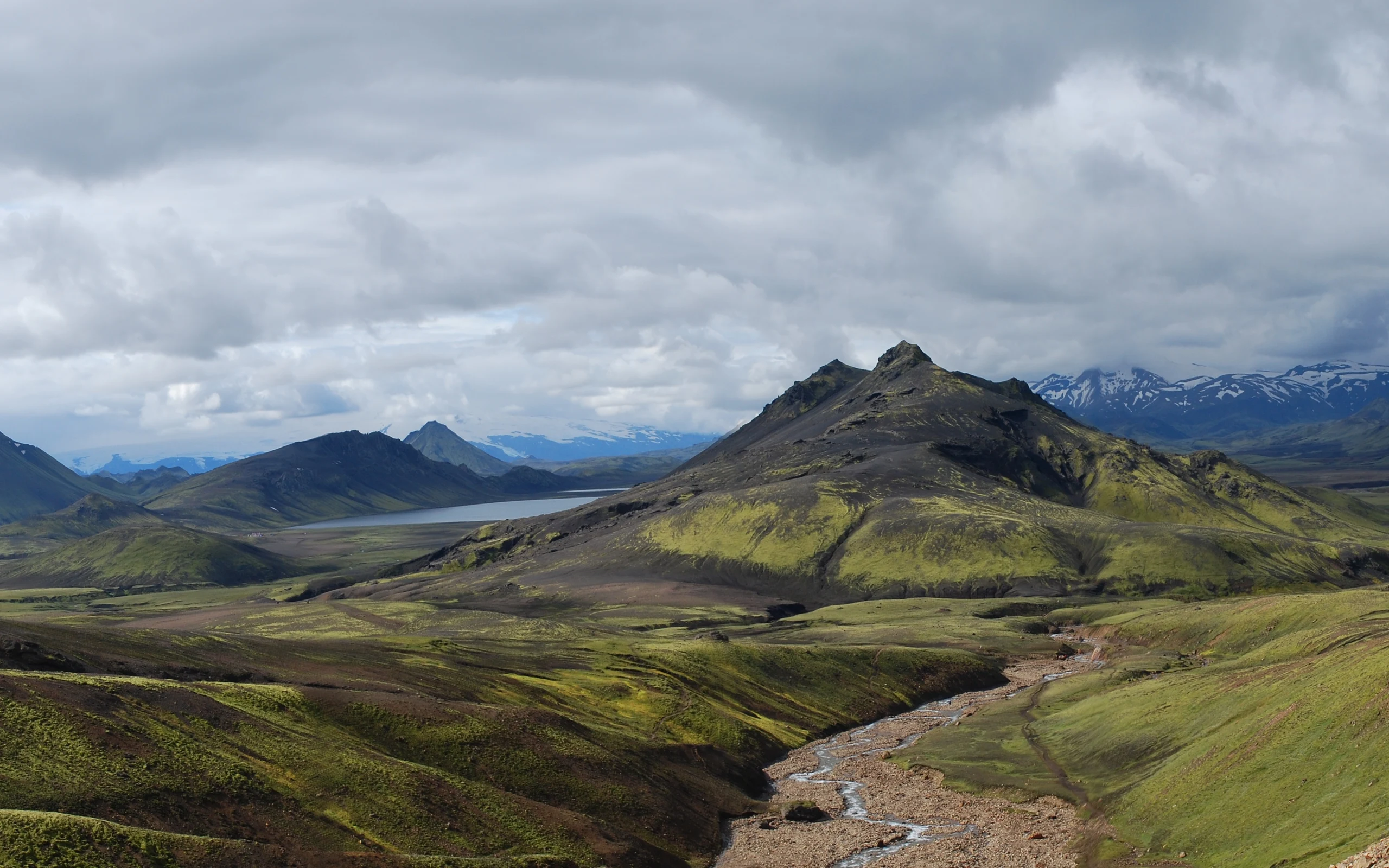
The best time to hike Iceland depends on which Iceland is meant. Landmannalaugar is represented by a 779.2 metre ERA5-Land cell in the Highlands, Skaftafell by a 328.7 metre cell near the great southern ice fields, and Þingvellir by a 333.1 metre cell farther west. Their public 1991–2025 records agree on July, August and September, but that agreement hides important differences. Landmannalaugar and Skaftafell pass the project's critical climate thresholds in exactly those three months. Þingvellir also passes in June and October. August ranks highest in both Highland and Skaftafell records, while July leads at Þingvellir. This is a climate comparison, not an opening calendar: road access, river crossings, snowpack and route maintenance are separate decisions.
August is the strongest overlap, not a dry-season promise
| Region | Temperature | Wet days | Monthly precipitation | Snow days | Score |
|---|---|---|---|---|---|
| Landmannalaugar | 8.2 °C | 60.74% | 112.8 mm | 2.86% | 76 |
| Skaftafell | 9.8 °C | 72.72% | 196.1 mm | 3.78% | 75 |
| Þingvellir | 10.7 °C | 54.29% | 116.7 mm | 0% | 81 |
August is the most balanced common month in these records. Modelled snow-day probability falls below four percent at all three cells, temperatures cluster between 8.2 and 10.7 °C, and mean daylight still ranges from 16.3 to 16.4 hours. Yet the rain pattern is not uniform. Skaftafell reaches 196.1 mm of mean monthly precipitation and a 72.72 percent wet-day probability. Landmannalaugar records 112.8 mm and 60.74 percent wet days; Þingvellir 116.7 mm and 54.29 percent. August therefore reduces the snow constraint without turning Iceland into a dry destination. Waterproof layers, flexible timing and a route-specific forecast remain central even in the highest-ranked overlap.
“In Iceland, the broadest daylight window arrives before the Highland snow signal has fully relaxed.”
Why June daylight does not open the same door everywhere
- MayLong light, closed climate gateMean daylight is about 18.4 to 18.5 hours, but snow-day probability is 71.89% at Þingvellir and 100% at both other cells.
- JuneÞingvellir moves firstIts snow-day probability falls to 7.62%; Landmannalaugar and Skaftafell remain above 92%.
- JulyThe common window beginsAll three pass, though modelled snow days still reach about 29% at the two more easterly cells.
- AugustThe cleanest overlapSnow pressure is lowest and every cell has more than 16 hours of mean daylight.
- September–OctoberThe window closes unevenlySeptember remains shared; in October only Þingvellir stays eligible, narrowly, with a score of 43.
June illustrates why daylight cannot stand in for ground conditions. Landmannalaugar has 20.7 hours of mean daylight, but its modelled snow-day probability is 92.67 percent and the score is capped at 49. Skaftafell shows the same 20.7 hours, 92 percent modelled snow days and the same cap. Þingvellir, by contrast, averages 21 hours of daylight, 9.8 °C and only 7.62 percent modelled snow days, so it enters its eligible calendar with a score of 79. September reverses the pressure: daylight falls to 13 hours, wet-day probability rises above 63 percent everywhere, and Landmannalaugar and Skaftafell record snow-day probabilities of 25.52 and 32 percent. Both still pass, but with scores of 58. The label 'September is eligible' should therefore be read as a threshold result with a narrow margin, not as an equal substitute for August.
For a trip that combines all three areas, August has the clearest historical case in this dataset. July offers more daylight but retains a larger snow signal at Landmannalaugar and Skaftafell. September remains within the shared calendar, yet it is colder, wetter and closer to the snow threshold. If the itinerary is limited to Þingvellir, June provides the longest days with a much lower snow signal than the other two records. October is technically eligible there, but 2.2 °C, a 49.59 percent snow-day probability and under ten hours of daylight make it a specialist margin rather than a simple extension of summer. Start with the regional calendar, then make the real decision from the exact route and current conditions.